
How a GOI lesson works
Perfectly structured, every lesson, every teacher. Yet fully customized, flexible and relevant. Your life is the material.
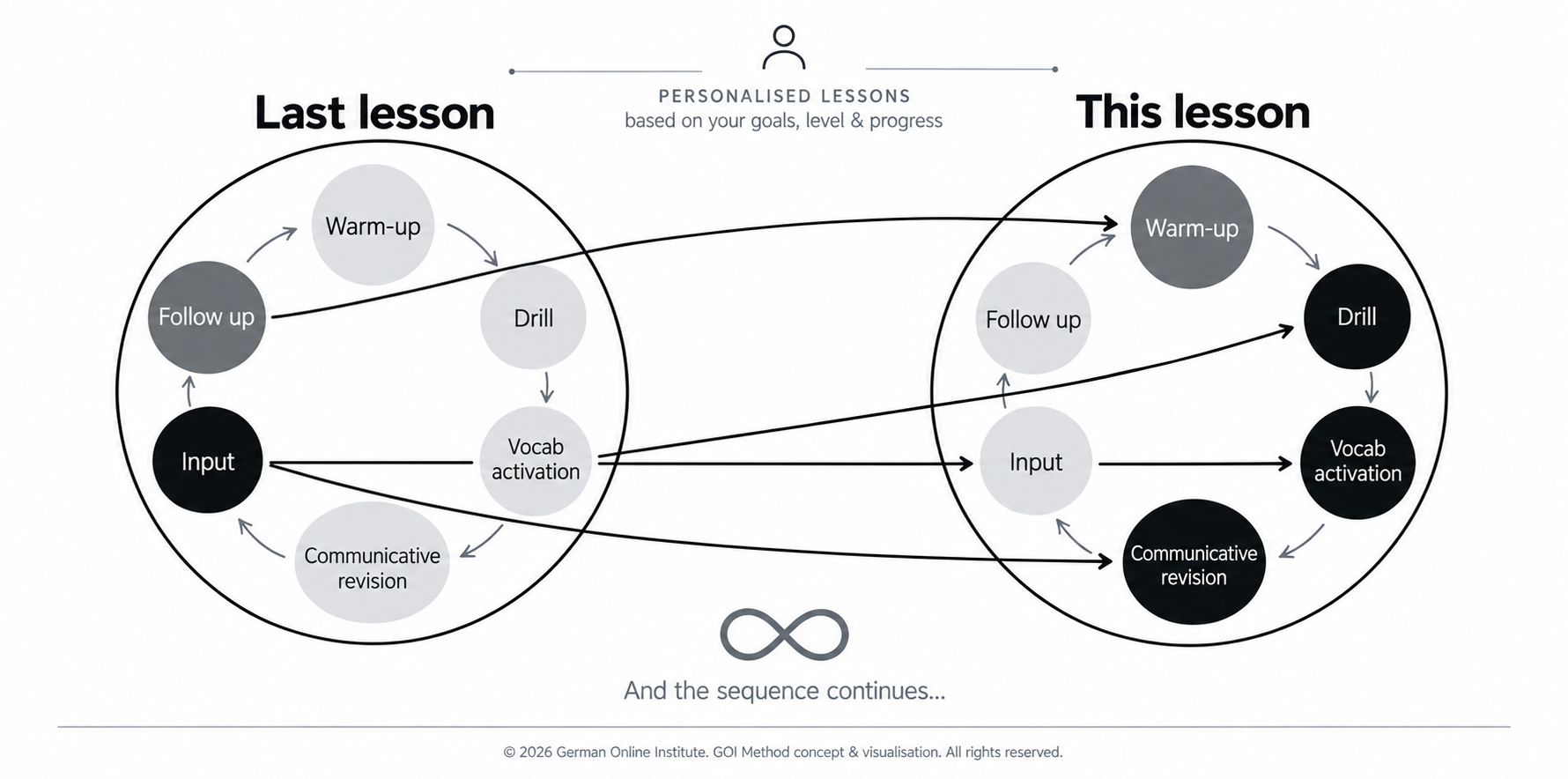
The GOI Method is the four-phase structure of every private German lesson at German Online Institute. Since 2026, every GOI teacher follows the same sequence: warm-up; revision with drill, vocabulary activation and communication; new input from the course book or authentic material, with practice and grammar; follow-up to plan the next lesson. Prepared from the learner's personal profile and documented on a fixed lesson board. Every lesson builds on the previous one. Exam prep follows it’s own structure with dedicated exam boards. Switch seamlessly between CEFR lessons and exam or naturalization prep.
Every lesson feeds the next
What you get wrong in conversation becomes next lesson's drill. What you tell your teacher about a new topic – how it touches your life – picks the material for next lesson's communicative revision. What you're about to do in German becomes next lesson's warm-up. Nothing you say wrong disappears into the air, and nothing you're about to face goes unprepared.
What a GOI lesson feels like
You won't just feel you're in good hands. You'll see it – every lesson, on the board.
At GOI every student has their own Google Classroom, and every lesson has an interactive, structured whiteboard showing precisely where you stand: which grammar, topics and skills you've touched, which you've mastered, and which are still ahead for your CEFR level. You always know where you are. Lessons are so flexible, that you can progress in your own speed, we fill in any blanks from past levels as you go or switch focus anytime (CEFR progression, business, exam or naturalization prep).
„For me?" 🧡
That's the moment our students notice: the mind map is about their last trip to Madagascar. The statistic is about their job. The vocabulary revision is the words they actually struggled with. The drill is their own mistake from last lesson. Not page 42 – theirs.
The lesson starts with a 5-min-warm-up
about a plan you shared at the end of the last one. Maybe it was small: "I'm taking the car to the mechanic on Thursday." Then your teacher asks how it went, and you tell it in German – a few sentences, and they're your sentences, about your Thursday. Maybe it was bigger: a job interview, a difficult conversation, a trip, a hike, someone coming to visit. Then that's what you talk about.
You talk about a real situation,
rather than “How is the weather?” or “How was your weekend?” and you decide how varied and colorful your warm-up will be. Either way, you chose it, you knew it was coming, and someone who knows exactly what to listen for helps you say it better.
Then last week's material comes back.
The one mistake that kept tripping you up
– that adjective ending you know perfectly well and keep getting wrong – gets three minutes of focused practice, and it stops tripping you.
The words you learned return.
– revise 3-5 new words you struggled with through a set of progressive exercises from matching descriptions, synonyms to building your own sentence.
And the last lesson’s topic returns, but as it is in your life.
E.g. If the book said "climate", and you happen to be a member of the Fridays for Future movement and live in Zurich, you'll may be reading and discussing about the city's net-zero walk – and walking it as homework, if you like. If you don't care about climate, you'll be doing something else entirely: Maybe analyzing a statistic on why many people dislike the topic, perhaps. Your teacher asked you about it in your last lesson, in passing, while introducing the topic to tailor the communicative revision skillfully so the topic touches you.
And while you speak, your teacher notes your main spoken grammar error and challenging vocabulary.
That's next week's revision prepared.
Then something new.
From a course book, or freestyle
We use Hueber publishing as a course book provider. (recommended for regular course progression A1-B2). Alternatively we can tailor your course from dynamic materials such as videos, audios, text-based materials of any kind, different mind map types, statistics and images – depending on how the topic touches you and you can bring your own materials of any kind.
New grammar
isn't explained to you; you're given a small puzzle and you find the rule yourself, and because you found it, it stays.
And at the end, five minutes to plan your next lesson together:
understood or not yet? Move on or stay with it? Homework, or none this week? Anything you'd like to bring in as a topic – a presentation, a visit to Munich? And what's coming up this week that we should talk about next time? It can be the mechanic. It can be anything. That's where next week's lesson begins.
It all goes on the board,
written down, so nothing is lost if you pause or switch teachers.
And it goes this way with every teacher, every time – because since 2026 that's how we teach.
The four phases
The GOI Method is the four-phase structure of every private German lesson at German Online Institute.
-
You talk about your own week. The garage appointment, the parents' evening, the meeting that went badly. You choose the topic at the end of the previous lesson; your teacher prepares for it.
-
Last lesson comes back, about you. D
Drill · Vocabulary Activation · Communication Drill:
Three minutes on the one error that cost you most last lesson – not a grammar lecture, targeted repetition until it sits.
Vocabulary Activation: last lesson's new words return.
Communication: last lesson's topic, but this time about your life and through real material – a short video, an authentic text, a website, a mind map or a picture that fits you and your level. Last week you learned how to describe a route in the textbook; today you describe your route to work. While you speak, your teacher notes the error that becomes next week's drill.
-
Something new or deepen skills, from the course book or freestyle – and one question: how does this topic touch your life?
Course book or flexible course progression · Practice & Grammar
A new topic or a deeper pass on the current one. Sometimes from a Hueber course book, or freestyle from real German – a video, an article, a website – chosen for you, not for a class of twenty. While you work on it, your teacher asks whether, when and how the topic has touched your life, or will. That answer decides what material and what angle next week's revision gets. New grammar is never explained first: you get a short GOI discovery task, find the rule yourself, and only then practice it.
-
Planning your next lesson. Progress or deepen? Anything unclear? Homework wanted? And what's happening in your life that we should talk about next week – your own topics always have a place here.
How Our Flexible System Works
-
🔄
Built-in revision
You never learn something once. It comes back the next lesson, applied to you.
-
🏋🏽♂️
Your errors, not a syllabus
Drills target what you actually got wrong, not what chapter 7 says.
-
🕵
Rules you find yourself
New grammar starts with a discovery task, not an explanation. What you work out, you keep.
-
🧡
Real German, chosen for you
New topics come with one question: how does this touch your life? The answer picks the revision angle & material.
FAQs
Frequently Asked Questions
What happens in a GOI lesson?
Every lesson follows the same four phases. It starts with a warm-up about something you announced last time, brings last lesson's material back – a short drill on your main verbal error, the new words, then conversation on the topic from the angle that concerns you – introduces something new, and ends with planning the next lesson together.
Will I forget everything between lessons?
No. Every lesson brings the previous one back before anything new is introduced – first drilled, then used in conversation about your own life. What you learned is revisited until it sits. You decide how long to deepen topics or when to move on to the next.
Am I paying for an hour of chatting?
No. Every lesson is prepared from your personal profile and follows the same structure. Conversation is one part of it; the drill, the revision, the new input and the planning are the rest.
What if my teacher leaves or is ill?
Your Classroom with all lesson records go to the substitute teacher. They continue from your last follow-up, not from zero. Every lesson prepares the next.
How is GOI different from a marketplace tutor?
A tutor sells you an hour of time. GOI sells you a lesson that was prepared for you, follows a fixed structure, is documented in writing and connects to the one before and the one after. Every GOI teacher works this way since 2026.
Does the free trial lesson follow the same structure?
Yes, in short form. You get a warm-up about you, a communicative exercise to enable a level check and a follow-up where we set your goals together and plan your course.
Do I have to use a course book?
No. Your teacher combines the course book with real material depending on your goals and how topics touch your life. A1-B2 students usually work with a hueber course book (recommended); B2-C-level students often work with videos, articles and websites that fit their life instead of course books. We tailor the course to your needs and goals with or without a course book.
Can I see my lesson record?
Yes, at any time. Everything from every lesson is documented in your personal Google Classroom.
Can I change what I'm working towards?
Yes, whenever you want. You can move from a CEFR course to exam preparation or naturalization and back, bring in your own topics, or revisit something you've forgotten. The structure stays the same; only the content changes.